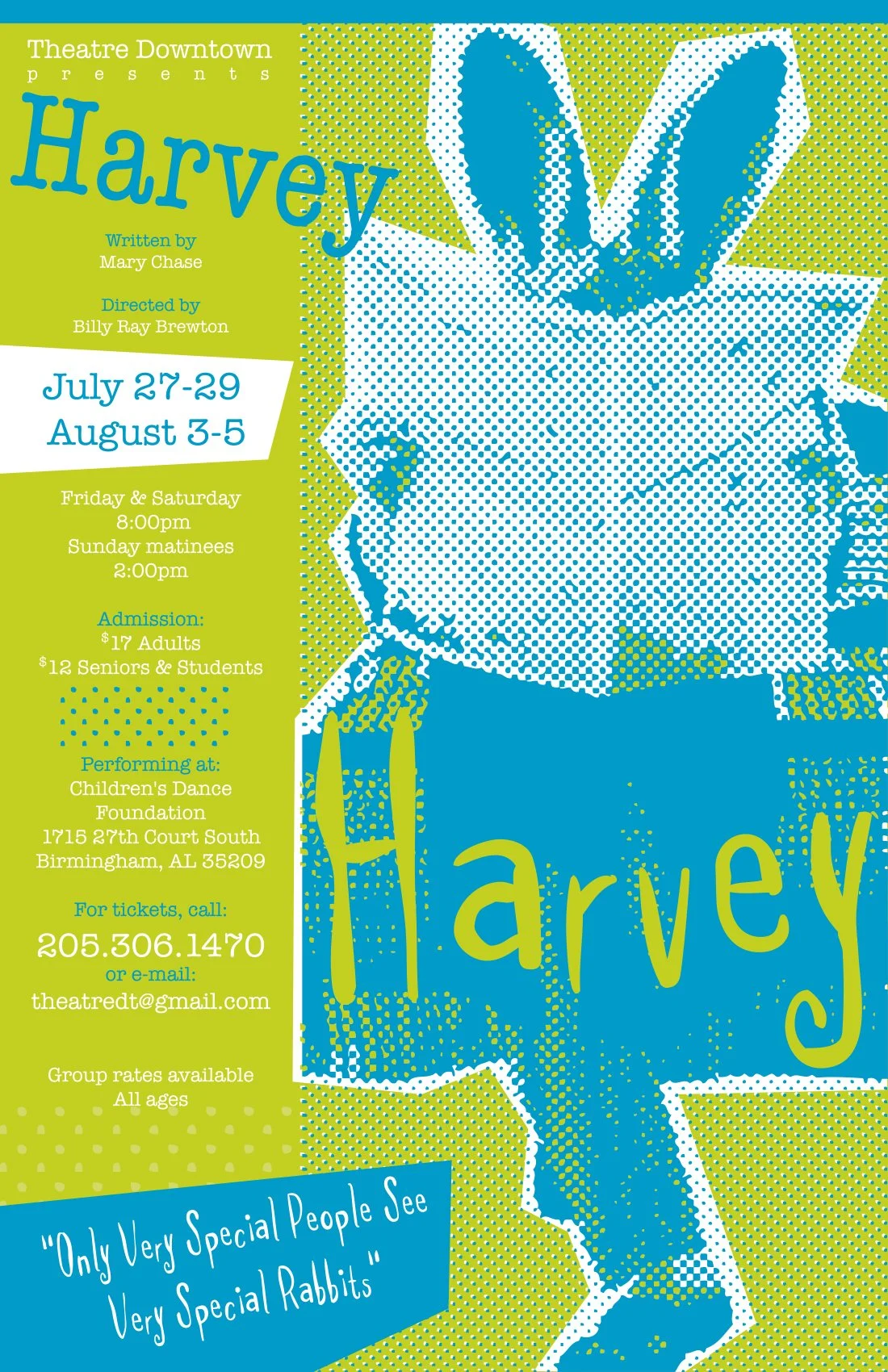
Harvey

Written By Mary Chase
Directed By Billy Ray Brewton

July 27-August 5, 2007
Friday-Saturday Nights at 8pm
Sunday Matinees at 2pm

Performed at Children’s Dance Foundation

Elwood P. Dowd insists on including his friend Harvey in all of his sister Veta’s social gatherings. Trouble is, Harvey is an imaginary six-and-a-half-foot-tall rabbit. To avoid future embarrassment for her family—and especially for her daughter, Myrtle Mae—Veta decides to have Elwood committed to a sanitarium. At the sanitarium, a frantic Veta explains to the staff that her years of living with Elwood’s hallucination have caused her to see Harvey also, and so the doctors mistakenly commit her instead of her mild-mannered brother. The truth comes out, however; Veta is freed, and the search is on for Elwood, who eventually arrives at the sanitarium of his own volition, looking for Harvey. But it seems that Elwood and his invisible companion have had a strange influence on more than one of the doctors. Only at the end does Veta realize that maybe Harvey isn’t so bad after all.

Featuring: Richard Scott, Dianne Daniels, Maree Jones, Terry Hermes, Russell Jones, Pam Cooper, Drew Brown, Diann Gogerty, Mary Anne Garrett, and Kevin Garrett

Mary Chase was born on February 25, 1907, in Denver, Colorado. Her first play to be professionally staged was ME THIRD (written in 1936), which was produced by the Federal Theatre Project, first in Denver and then the following year in New York, directed by Brock Pemberton under the title NOW I’VE DONE IT. Her next play, A SLIP OF A GIRL (1941), folded on tryout, and other plays of that time, including BANSHEE, similarly got nowhere. Between 1941 and 1944 she became publicity director for the National Youth Administration in Denver, and then for the Teamsters’ Union. Nothing daunted, Brock Pemberton was so confident of Mrs. Chase’s ability that he undertook to produce a piece called THE WHITE RABBIT, on the condition that its title be changed to HARVEY. Its opening in November 1944 became history. The play was an immediate hit and won its astonished author the Pulitzer Prize for 1944-45. Ironically, after the triumph of HARVEY, Mary had to wait until 1952 for her next success, when Helen Hayes starred in MRS. McTHING. This was another bit of whimsical fantasy in which, with the help of a spot of witchcraft, a snobbish woman is made to accept the qualities of her roughneck son rather than trying to idealize him as the prissy brat she really wanted. "The Saturday Review" remarked: “It is exciting to find how the charm and originality of MRS. McTHING come out in the printed play almost as vividly as they do on the stage… Here is a fantasy that is also convincing realism.” She had another success the following year with BERNADINE, a play about Wromy, an ineffectual teenage boy who tries to translate his gang’s fantasies about the ideal woman into everyday life, with ridiculous results. BERNADINE was later turned into a successful Hollywood movie starring Pat Boone. Mary Chase’s last play to reach new York was MIDGE PURVIS (1961), in which Tallulah Bankhead played a rich matron who passes as a doddering crone. In addition to plays and films, Mary Chase wrote two children’s novels. Reviewing the first of these, "Loretta Mason Pots," "The Chicago Tribune" observed: “How right and natural that the creator of HARVEY and MRS. McTHING should now write a magical tale for boys and girls. Surely Loretta Mason Potts will take her place among the memorable characters of children’s literature and her story should be a favorite for a long time to come.”